
Olive leaf extract standardized in Oleacein and Oleuropein for industrial and professional use only. Not intended for sale to final consumers.
The OLEACIN® water solubility makes it suitable to both cosmeceutical preparation and nutraceuticals, where it could be used as it is or diluted with water, coffee or other drinks. The bioavailability of the product is promoted by its fluid form (1).
The antimicrobial activity of olive leaf extract make it of interest for food producers interested in natural preservatives(2).
OLEACIN® is an alcohol-free olive leaf (Olea europea L.) extract, manufactured in Liguria, Italy, by Arisi Giacomo &Figli S.r.l
It is available in several standardized concentrations of Oleacein (hydroxy-oleocanthal) and Oleuropein, in powder and fluid form.
Both Oleacein and Oleuropein are natural food preservative agents, but Oleacein possess the strongest antimicrobial activity even compared with Hydroxytyrosol. (10)
In its fluid form, OLEACIN® is a pasteurized viscous-fluid product, its taste is typical and, considering the high polyphenols concentration, not particularly bitter. This allows to use it in many formulations without altering significatively the taste of the final product.
In powder form, the product is available, for industrial use, in 1 kg bag in box (5 bags per master carton), the fluid form is available in 1 L glass jar or 3 L bag in box.
Oleacein
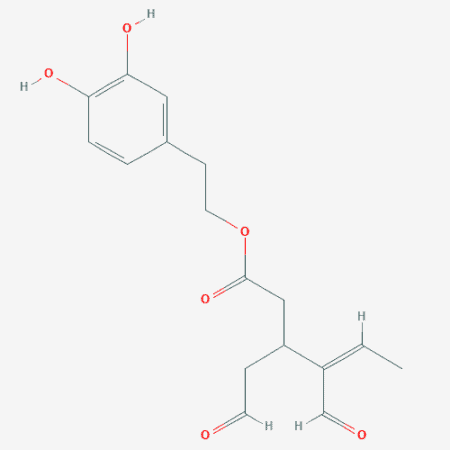
Oleacein is a secoiridoid, a subclass of iridoids formed by the opening of the cyclopentane ring, and one of the main polyphenols inextra virgin olive oil. Secoiridoids are typical of the Oleaceae family, and in particular of the olive tree (Olea europaea l.).
Oleacein derives from oleuropein: its intermediate, Oleauropein aglycone, takes the more stable form of decarboxymethyl elenolic acid dialdehyde esterified with hydroxytyrosol.
His molecular formula is: C17H20O6 and it has a molecular weight of 320.3 g/mol
In vitro tests showed antinflammatory, antiatherosclerotic and antihypertensive properties of Oleacein, this last one by the inihibition of the angiotensin conversion enzyme, moreover, Oleacein is an inhibitor of the mammalian/mechanistic target of rapamycin (mTOR), an important metabolism and cellular growth regulation mechanism related to lifespan and aging.(5)(9)
New data, that are being accumulating, indicates Oleacein as the main responsible of the positive effects of olive oil on cardiovascular system.(4) Oleacein results, also, to be an inhibitor of MTOR pathway, an important methabolism and cellular growth regulation mechanism.(5)
Oleacein is mainly absorbed and enters the human systemic circulation in reduced forms as glucuronides, but it appears that it is released from glucuronides by the lysosomal Beta glucuronidase secreted by inflammatory macrophages at the site of inflammatory activity.(6)(7)
Oleuropein
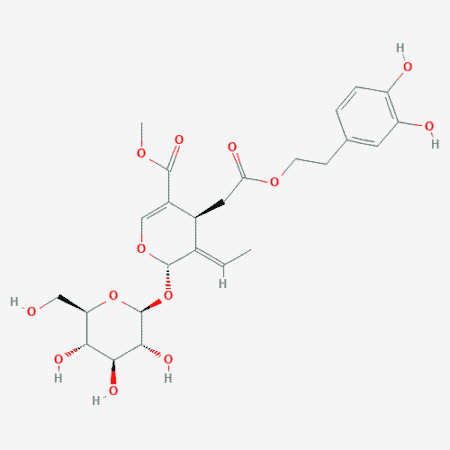
Oleuropein is a secoiridoid and the main polyphenol present in olive leaves. It is also contained in the olive fruit where it confers the typical bitter taste. This bitter taste is removed by the table olives during the oleuropein degradation derived from the lactic fermentation or by sodium hydroxide treatment.
Oleuropein is not particularly abundant in extra virgin olive oil, as it is replaced by oleacein and oleuropein aglycone.
Its structure contains an ortho-diphenolic (catechol) group, which can neutralize reactive oxygen species by hydrogen donation in chemical assays.
His molecular formula is: C25H32O13 and it has a molecular weight of 540.5 g/mol
Oleuropein has been object of many studies, in vitro test, and tests on human volunteers.
The antioxidant properties are connected with its chemical structure, containing an orthodiphenolic group able to demolish the reactive oxygen species (ROS) by hydrogen donation.(8) The Oleuropein antinflammatory properties are related to its ability to inhibit the production of cytokines and chemokines as the interleukin-1beta (IL-1β) and interleukin 6 (IL-6).(7)
Quality and analytical controls:
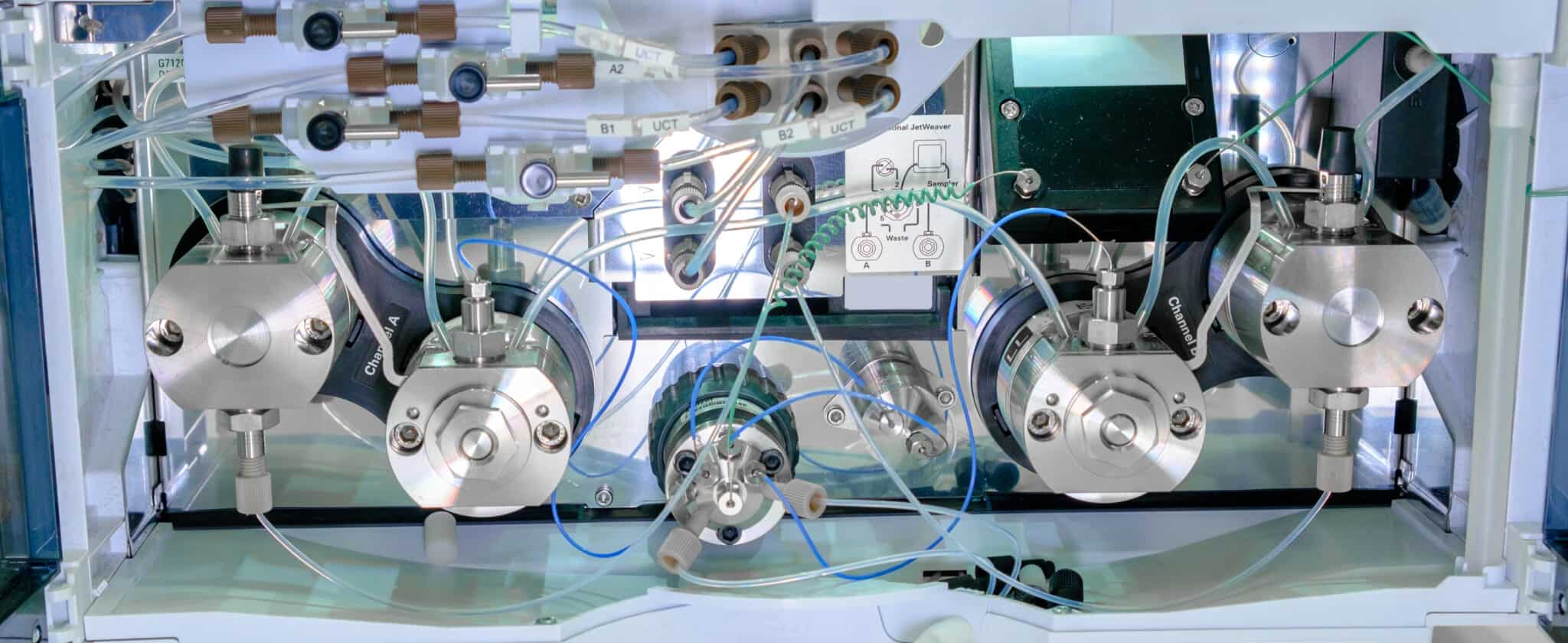
Every batch of OLEACIN® is analyzed by HPLC-MS/MS to quantify Oleuropein and Oleacein. The product is also tested for:
- Microbiological analysis
- Pesticide analysis
- Heavy metals analysis
- water activity analysis
Contact us for more information on OLEACIN®
Bibliography:
(1)de Bock M. “Human absorption and metabolism of oleuropein and hydroxytyrosol ingested as olive (Olea europaea L) leaf extract” Molecular Nutrition and Food Research 57 (2013) p: 2079-2085
(2)Saleh E. et Al. “Effects of olive leaf extracts as natural preservative on retailed poultry meat quality” Foods (2020), 9, 1017 p. 1-12
(3)Emma M. R. et Al. “Potential uses of olive oil secoiridoids for the prevention and treatment of cancer: a narrative review of preclinical studies” Int. Jour. Of Molecular Sciences 22, 1234 (2021) p: 1-22
(4)J. Lozano-Castellon et Al. “Health-promoting properties of oleocanthal and oleacein: two secoiridoids from extra virgin olive oil” Critical Rev. In Food Science and Nutrition 60 (2020) issue 15 p: 2532-2548
(5)S. Carpi et Al. “miRNA modulation and antitumor activity by the extra virgin olive oil polyphenol oleacein in human melanoma cells” Frontiers in Pharmacology 11 (2020) p. 1- 12
(6)A. Filipek et Al. “Oleacein may intensify the efflux of oxLDL from human macrophages by increasing the expression of the SRB1 receptor, as well as ABCA1 and ABCG1 transporters” Journal of Functional Foods 78 (2021) p: 1-10
(7)Pinto, J et Al. “Absorption and metabolism of olive oil secoiridoids in the small intestine” Br. J. Nutr. 105 (2011) p: 1607-1618
(8)Nediani C. et Al. “Oleuropein, a bioactive compound from Olea europaea L., as a potential preventive and therapeutic agent in non-communicable diseases” Antioxidants 8,578; (2019) p: 1-26
(9)Papadopoli D. et Al. “mTOR as a central regulator of lifespan and aging”. F1000Research 2019, 8(F1000 Faculty Rev):998 Last updated: 28 May 2020, pp. 1-21
(10)PThielmann J. “Antimicrobial activity of Olea europaea Linné extracts and their applicability as natural food preservative agents” International Journal of Food Microbiology 2017, 251, pp. 48-66